What Kind of Pants Did Cowboys Wear in the 1800s?
, by Syed Khawar Bukhari , 13 min reading time
, by Syed Khawar Bukhari , 13 min reading time
When we picture a cowboy from the 1800s, the image is almost always the same: a wide-brimmed hat, worn leather boots, a dusty bandana, and a pair of rugged pants that look like they've seen a hundred miles of trail. But what exactly were those pants? What kind of pants did cowboys actually wear in the 1800s, and why did they choose what they chose? The answer is more interesting than most people expect, and it tells a vivid story about practicality, culture, and the demands of life on the open range.
Cowboys in the 1800s were working men. They spent long hours in the saddle, wrangling cattle across vast stretches of terrain that could shift from rocky desert to muddy riverbank within a single day's ride. Their clothing had to keep up with all of that. There was no room for fashion that couldn't survive a hard day's work, and pants were at the center of that equation. A cowboy needed pants that could handle chafing from the saddle, resist tears from brush and thorns, stay comfortable in heat and cold, and still allow enough movement to rope, dismount, and work on foot when needed.
This is why the story of cowboy pants is really a story about function first, everything else second.
Cowboys in the 1800s most commonly wore wool trousers, canvas pants, and later, denim jeans. Each of these served a specific purpose depending on the era, the region, and what a cowboy could afford or access. Before Levi Strauss made denim famous in the 1870s, wool and canvas were the dominant materials. After the rise of riveted denim jeans, the landscape of cowboy fashion changed dramatically and permanently.
Before denim took over, wool was the fabric of choice for working cowboys across much of the American West. This might seem surprising to modern readers who associate wool with itchy winter sweaters, but the wool trousers of the 1800s were practical for several important reasons.
Wool is naturally durable and resistant to tearing. It also regulates body temperature better than many people realize, keeping the wearer warm in cold mornings and moderately cool during the heat of the day by wicking moisture away from the skin. For cowboys who faced wildly unpredictable weather on the open range, this made wool a smart choice.
These trousers were typically cut straight and loose compared to modern fits, with a high waist and no rear pockets in the earliest styles. They were often held up by suspenders, since belt loops weren't yet standard on most trousers. Cowboys might wear these pants in dark colors like brown, gray, or black to hide dirt and staining from long days of work.
Canvas trousers were another popular option among cowboys in the mid-1800s, particularly in the years before Levi's became widely available. Canvas is a thick, tightly woven cotton fabric that is extremely resistant to tearing and abrasion. It was the kind of material used to make tents and wagon covers, which gives you a sense of just how rugged it was.
Cowboys appreciated canvas for its durability in rough terrain. When riding through brush country in Texas or navigating rocky canyons out West, canvas pants held up better than lighter fabrics. They were heavier than wool and didn't breathe as well, but for men who prioritized function over comfort, that was an acceptable trade.
Canvas pants were often a natural tan or off-white color, though they would quickly darken with trail dust and use. Some cowboys would treat them with grease or wax to make them more water resistant, which added another layer of practicality to an already tough garment.
No conversation about cowboy pants in the 1800s is complete without talking about Levi Strauss and the invention of riveted denim jeans. In 1873, Levi Strauss and his business partner Jacob Davis received a patent for their design of copper-riveted work pants made from denim. The rivets were placed at the stress points of the trousers, such as the pocket corners, to prevent tearing under the strain of hard physical labor.
These pants were originally marketed to miners during the California Gold Rush era, but they quickly caught on with cowboys across the West. The reasons were obvious: denim was even more durable than canvas in many respects, it was relatively affordable, and the riveted design meant the pants would last far longer than anything else available at the time.
Denim jeans became the go-to pant for cowboys for several practical reasons beyond just durability. The fabric softened with wear and washing, eventually conforming to the shape of the wearer's body. For a man who spent eight to twelve hours a day in the saddle, this kind of fit mattered enormously.
Early Levi's jeans featured a cinch back instead of belt loops, a detail that reflected the era's preference for suspenders over belts. They also had a watch pocket, which cowboys found useful for storing small tools or pocket watches. The high rise of these early jeans sat comfortably over the hips and lower back, providing coverage and warmth that a lower rise couldn't offer.
By the 1880s and 1890s, denim jeans had become synonymous with the cowboy lifestyle across much of the American West. They were worn tucked into boots or cuffed at the bottom, and they aged into a pale, faded blue that has since become one of the most iconic looks in American fashion history.
While not pants themselves, chaps played a critical role in the cowboy's lower body wardrobe and deserve mention in any thorough discussion of what cowboys wore below the waist. Chaps are leather leg coverings worn over trousers to protect the legs from brush, thorns, rope burns, and the friction of the saddle.
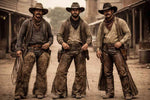
Cowboys used different styles of chaps depending on their region and the work at hand. Shotgun chaps, which were tight fitting and cylindrical like a shotgun barrel, were popular in Texas and the southern plains. Batwing chaps, which flared out dramatically at the bottom, were more common in the later 1800s and into the early 1900s. Woolly chaps, made with the fleece still attached to the leather, were favored in colder northern climates and mountain regions.
Leather chaps were buckled around the waist and down the outer leg, leaving the seat and inner thigh uncovered so that the cowboy could still feel the horse beneath him. When a cowboy was working in heavy brush or rocky country, chaps went on over whatever trousers he was wearing, providing an extra layer of protection that could mean the difference between a minor inconvenience and a serious injury.
It's worth noting that cowboy pants weren't uniform across all regions of the American West. Geography, climate, and cultural influences from Mexico all played a role in shaping what cowboys wore.
In Texas, where the cattle industry boomed and the brush country was thick with thorns, cowboys tended to favor heavier, more protective pants. Mexican vaquero influence was strong here, and many Texas cowboys adopted elements of vaquero style, including chaparreras (the original Spanish word that gave us "chaps") and trousers with a wider cut in the leg.
Cowboys working in Wyoming, Montana, and the northern ranges faced much colder winters than their counterparts in Texas. Here, heavy wool trousers remained popular longer, and cowboys often layered their pants with long underwear made of wool or cotton to survive freezing temperatures on the range.
California had its own strong vaquero tradition that predated the American cowboy by generations. California vaqueros often wore more elaborate and decorative trousers, influenced heavily by Spanish and Mexican fashion. These included tight-fitting pants with decorative stitching, often made from fine wool or leather. The working cowboy of California blended practicality with a flair for style that reflected the region's Spanish colonial heritage.
Cowboys in the 1800s weren't particularly fashion conscious, but there were some consistent details across the pants of the era worth noting. Most trousers of the period featured a straight leg cut with a generous rise. Waistbands were wide, often three inches or more, and designed to accommodate suspenders rather than a belt.
Dark and neutral colors dominated, for the simple reason that they hid dirt better. Brown, gray, black, and dark blue were all common. After the rise of denim, the distinctive indigo blue of unwashed or lightly washed jeans became part of the cowboy's visual identity.
Some cowboys who had a little more money might have their trousers made by a local tailor or ordered through a mail-order catalog, which became increasingly common in the later decades of the 1800s with companies like Montgomery Ward and Sears Roebuck offering ready-made clothing to rural customers.
It's just as useful to understand what cowboys in the 1800s avoided as it is to understand what they wore. Cowboys did not wear shorts, for obvious reasons related to sun exposure, brush, and saddle friction. They generally did not wear light or brightly colored trousers that would show dirt quickly. And despite what some Hollywood Westerns might suggest, fitted or tailored dress trousers were reserved for special occasions like trips to town, and were not worn on the range.
The legacy of 1800s cowboy pants is enormous and continues to shape fashion today. Denim jeans, born out of the practical needs of working cowboys and miners, have become perhaps the most universally worn garment in the world. The straight-leg cut, the high rise, and even the five-pocket design of modern jeans trace their lineage directly back to the work pants of American cowboys in the latter half of the 1800s.
Western-style clothing continues to be popular not just as workwear but as a genuine fashion statement. The resurgence of Western chic in contemporary fashion, with designers incorporating elements like yoke stitching, boot cuts, and raw denim into high-end collections, is a direct nod to the durable, honest aesthetic that cowboy clothing pioneered more than a century ago.
So, what kind of pants did cowboys wear in the 1800s? The answer evolved significantly over the course of the century. Early cowboys relied on wool trousers and canvas pants because they were durable, accessible, and well-suited to the punishing demands of life on the open range. As the decades passed and Levi Strauss introduced his riveted denim jeans in 1873, the cowboy wardrobe shifted, and denim became the defining fabric of the American West. Cowboys layered their trousers with chaps for added protection, adapted their clothing to regional climates, and cared far more about function than fashion. The result was a practical, rugged wardrobe that has left an indelible mark on American clothing culture and continues to influence what we wear today.
Q1: What were the most common pants cowboys wore in the 1800s?
Cowboys most commonly wore wool trousers, canvas pants, and denim jeans. Denim became the most popular choice after Levi Strauss introduced riveted jeans in 1873.
Q2: Did cowboys wear Levi's jeans in the 1800s?
Yes, but only from 1873 onward. Levi Strauss and Jacob Davis patented their copper-riveted denim jeans that year, and cowboys quickly adopted them for their durability and affordability.
Q3: Why did cowboys wear chaps over their pants?
Cowboys wore chaps to protect their legs from thorns, brush, rope burns, and saddle friction. They were made of leather and buckled over regular trousers during tough riding conditions.
Q4: Did cowboys wear belts or suspenders with their pants?
Most cowboys in the 1800s wore suspenders rather than belts, since early trousers were not designed with belt loops. Belts became more common toward the end of the century.
Q5: What colors were cowboy pants in the 1800s?
Cowboys favored dark, neutral colors like brown, gray, black, and dark blue because they hid trail dirt and stains better than lighter shades, making them far more practical for daily range work.




$129.95 - $159.95
$139.95 - $169.95


$139.95 - $169.95