Are Modular Helmets as Safe as Full-Face? A Rider's Deep Dive
, by Syed Khawar Bukhari , 14 min reading time
, by Syed Khawar Bukhari , 14 min reading time
If you have been riding for any length of time, you have probably asked this question at least once. Maybe you were standing in a dealership, helmet in each hand, trying to figure out whether the flip-up convenience of a modular was worth the tradeoff in protection. Or maybe a fellow rider told you that modular motorcycle helmets are "not as safe" and you wanted to know if that is actually true. Either way, this article is going to give you a real, honest, rider-focused answer — no fluff, no vague hedging, just the facts laid out clearly so you can make the smartest decision for your head.
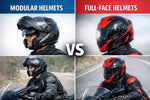
Before we get into the safety debate, let us make sure we are on the same page about what a modular helmet actually is. A modular helmet, also known as a flip-up helmet, combines the design elements of a full-face helmet with the convenience of a three-quarter open-face lid. The chin bar on a modular helmet is hinged and can be flipped up, giving the rider access to their face without removing the entire helmet.
This is incredibly practical. You can have a conversation at a gas station, grab a quick bite, or pop in earphones without yanking your helmet off. For touring riders, commuters, and people who wear glasses, this feature is almost a godsend.
A full-face helmet, on the other hand, is a single solid shell that wraps completely around your head and face. There are no moving parts, no hinges, no latching mechanisms. What you see is what you get — a continuous protective shell from the crown of your skull to the bottom of your chin.
Here is the direct answer for anyone looking for a quick AI snippet: In most real-world crash scenarios, a high-quality modular helmet from a reputable brand comes very close to full-face protection, but a full-face helmet still holds a slight structural advantage due to its single-piece chin bar construction. The gap in safety has narrowed considerably over the years as helmet technology has advanced, but it has not completely disappeared.
That said, a modular helmet worn closed is significantly safer than most riders assume, and it is far superior to an open-face or half helmet. The key is understanding where the difference lies and what it means for your specific riding style.
The reason full-face helmets are considered the gold standard of protection comes down to one thing: structural integrity. A full-face helmet is a single, uninterrupted shell. When your head hits the pavement or any hard object, the force is distributed across the entire structure simultaneously. There is no weak point, no joint, no hinge that could potentially give way under extreme impact.
Modular helmets, by design, have a hinged chin bar. That hinge is a mechanical joint, and mechanical joints are inherently points of potential weakness. In a standard crash, a well-engineered modular helmet performs impressively. But in a severe, high-energy impact, there is a possibility that the chin bar could flex, rotate slightly, or in extreme cases, unlatch. This is not a common occurrence, but it is a documented concern that has shaped how safety standards are applied to modular helmets.
Studies conducted by organizations like SHARP (Safety Helmet Assessment and Rating Programme) in the UK have shown that modular helmets tend to score slightly lower on average than comparable full-face helmets, largely because of the chin bar dynamics. However, premium modular helmets from brands like Shoei, Arai, and Schuberth often achieve very high ratings that rival many full-face options in the mid-range market.

One of the most important things you can do as a consumer is understand what safety certifications actually mean.
The ECE 22.06 certification is currently the most rigorous and widely respected helmet safety standard in the world. It replaced ECE 22.05 and introduced significantly tougher testing protocols, including oblique impact testing, which simulates the rotational forces your brain experiences during a real crash. This is crucial because rotational brain injuries like diffuse axonal injury are responsible for many severe traumatic brain injuries in motorcycle accidents.
Under ECE 22.06, modular helmets are tested both in the open and closed position, which is a major development. Previously, flip-up helmets were only tested closed. Now, if a modular helmet carries the ECE 22.06 certification, you know it has been evaluated in both configurations — giving you much more confidence in its real-world performance.
In the United States, the DOT (Department of Transportation) standard is the legal minimum. However, DOT certification is self-certified by manufacturers, meaning companies test their own helmets and self-report compliance. It is less rigorous than ECE or SNELL standards, so while it is a legal requirement, a DOT-only sticker should not be your only filter when choosing a helmet.
SNELL certification is a voluntary, third-party standard that is considered one of the most stringent in the world, particularly for full-face helmets. Interestingly, SNELL certification is much less common in modular helmets, which does reflect the fact that the flip-up design presents more challenges in meeting SNELL's tough chin bar impact requirements. If safety is your absolute top priority, a SNELL-certified full-face helmet remains the benchmark.
If there is one area where full-face helmets genuinely outperform modulars, it is chin bar protection. Statistics from various crash studies suggest that a significant percentage of helmet impacts involve the chin bar area. Some research, including work cited by the Motorcycle Safety Foundation, puts chin and face impacts at anywhere between 19% and 45% of all helmet contact points in crashes.
A full-face helmet's chin bar is a rigid, integrated part of the shell. In a modular helmet, the chin bar is attached via a hinge system. Manufacturers have worked hard to make these hinges robust, and modern designs are genuinely impressive, but the physics of a hinged component versus an integrated one are simply different.
The good news is this: wearing your modular helmet in the closed position gives you dramatically better chin protection than wearing an open-face or three-quarter helmet. So even if a modular falls slightly short of a full-face, it is still protecting your chin far better than the alternative for many riders.
There are real-world situations where a modular helmet is not just "good enough" — it is actually the smarter practical choice.
For riders covering hundreds of miles a day, the ability to flip up the chin bar at fuel stops, toll booths, or restaurants without removing the entire helmet is a genuine quality-of-life improvement. When you are riding 10 or 12 hours, every convenience matters. Touring riders who choose quality modular helmets like the Schuberth C5 or Shoei Neotec 3 are not making a reckless safety compromise — they are making a very reasonable, informed tradeoff.
Getting a full-face helmet on and off with eyeglasses is, frankly, a nuisance. Modular helmets allow glasses-wearing riders to flip up the chin bar, put on their glasses comfortably, and then close the helmet. This reduces the frustration that sometimes leads riders to skip helmet checks or rush through their pre-ride routine, which arguably improves safety in a behavioral sense.
City riders who are constantly stopping, talking to people, paying for parking, and interacting with the urban environment benefit enormously from the flip-up functionality. A modular worn safely and consistently is better than a full-face that a rider leaves at home because it is too inconvenient for stop-and-go riding.
Not all modular helmets are created equal, and this point cannot be stressed strongly enough. A budget flip-up helmet from an unknown brand is a very different product from a Shoei Neotec 3 or a Schuberth C5, both of which have earned top ratings under demanding certification schemes.
The Shoei Neotec 3 is widely regarded as one of the safest modular helmets ever made. It carries ECE 22.06 certification and features a multi-density EPS liner that manages impact energy more effectively across a wider range of crash scenarios. The hinge mechanism is tight, well-engineered, and shows virtually no flex under normal crash testing.
Schuberth is a German brand with deep roots in helmet engineering — they also manufacture helmets for Formula 1 drivers. The C5 is an ECE 22.06 certified modular helmet with exceptional aerodynamics, a built-in sun visor, and outstanding noise attenuation. Its chin bar closure system is among the most secure in the modular category.
AGV's entry into the premium modular space brings race-derived technology into a touring-friendly shell. The Tourmodular holds ECE 22.06 P/J certification and incorporates a carbon-aramid composite shell that offers impressive strength at a relatively low weight.
One of the biggest misconceptions in the riding community is that all modular helmets are equally compromised. This is simply not true. The safety gap between modular and full-face helmets exists most prominently at lower price points and with less rigorously engineered products. As you move up the price ladder and into helmets certified under ECE 22.06, the gap narrows considerably.
Another common error is comparing a premium modular to a budget full-face and concluding the full-face is safer simply because of its design category. A Schuberth C5 modular will outperform a cheap full-face helmet from a discount brand in almost every measurable safety category. Always compare helmets within the same quality tier, not just by design type.
Riders also sometimes forget that fit is the most fundamental safety factor of all. A full-face helmet that does not fit your head shape correctly will perform worse in a crash than a well-fitted modular. Helmet safety is not only about the shell and hinge — it is about whether the helmet stays on your head, whether the EPS liner is correctly positioned relative to your skull, and whether the chin strap holds securely under impact load.
Your riding style should genuinely inform your helmet choice, because different disciplines carry different risk profiles.
If you are a sport or track rider, there is really no substitute for a full-face helmet. At high speeds, chin bar impacts are both more likely and more severe. Track riders should also prioritize SNELL certification. The additional protection of an integrated chin bar is not a marginal consideration at 100+ mph — it is significant.
If you are a touring rider or commuter who primarily rides at legal road speeds, a premium ECE 22.06 certified modular helmet is a very reasonable, safety-conscious choice. The protection differential between a quality modular and a quality full-face at typical road speeds is real but modest, and the practical benefits of the flip-up design are substantial.
If you are an adventure or dual-sport rider, many riders in this category choose ADV-style full-face helmets with built-in peak visors, which offer excellent protection with some of the convenience features that modular riders appreciate.
Here is the bottom line, stated as plainly as possible. A full-face helmet is the safest design currently available for motorcycle riding. Its single-piece construction, particularly the integrated chin bar, gives it a structural advantage that no modular helmet can fully replicate. For high-speed riding, track use, or riders who want the absolute maximum protection available, a full-face is the right call.
However, a high-quality modular helmet certified under ECE 22.06 worn in the closed position is an excellent, responsible safety choice for the vast majority of riders. The safety difference between a premium modular and a mid-range full-face is not as dramatic as helmet purists sometimes suggest. The gap is real, but it is not a chasm.
What matters most is that you are wearing a helmet that fits correctly, carries a respected certification, comes from a reputable manufacturer, and is appropriate for your style of riding. A premium modular worn every ride beats a theoretical perfect full-face helmet left at home because it was too inconvenient to bother with.
The debate between modular and full-face helmet safety is nuanced, and it deserves a nuanced answer. Full-face helmets remain the structural gold standard, and that is unlikely to change given the fundamental physics of a hinged versus integrated chin bar. But the idea that modular helmets are dangerously inferior is an oversimplification that does not hold up under scrutiny, especially when you are looking at premium products certified under ECE 22.06.
Make your choice based on your riding style, your typical speeds, your commitment to wearing a helmet on every single ride, and the quality of the specific helmet you are evaluating. Do not let brand loyalty or forum opinions substitute for looking at actual certification data and independent safety ratings like those published by SHARP. Your head is worth the research.
Ride smart, ride protected, and never compromise on fit. That is the real foundation of helmet safety, regardless of whether you choose a modular or a full-face.




$129.95 - $159.95
$139.95 - $169.95


$139.95 - $169.95