What Does a Safety Pin Mean on a Biker's Vest?
, by Syed Khawar Bukhari , 18 min reading time
Quick Answer
A large safety pin on a biker's vest is most often a pass-through pin. Riders wore it to tell other motorcycle clubs they were only passing through an area and meant no challenge to local territory. Smaller pins can mean something else: punk style, a personal tribute or, since 2016, a quiet signal of solidarity. The meaning depends on the pin's size, its placement and the rider wearing it.
Key takeaways
In 1849, a New York mechanic named Walter Hunt patented a coiled piece of wire with a clasp and sold the rights for $400. Nearly two centuries later, that small invention sits on leather in places Hunt never imagined, from punk stages to protest marches to the front of a rider's cut. A safety pin on a biker's vest can carry several meanings at once, and most explanations online flatten them into a vague story about unity and rebellion.
The documented answer is more specific. Within motorcycle club culture, a large safety pin is traditionally a pass-through pin, a courtesy signal worn when riding through another club's territory. Smaller pins draw on two other traditions: the do-it-yourself look of 1970s punk and the solidarity pins that spread in 2016. Telling them apart takes a little context.
This guide separates what is well documented from what is folklore. It covers the history of biker vests, the origin of the pass-through pin, punk and allyship symbolism, the etiquette around wearing pins on colors, and practical advice for adding one to a leather or denim vest without damaging it.
Within motorcycle club culture, the large safety pin has a name: the pass-through pin, sometimes called a pass pin. According to SlashGear's 2025 explainer, members wore it on their cuts whenever they rode outside their own club's territory. The message was simple. The rider was heading somewhere else, was not trying to plant a new chapter on rival ground and intended no disrespect. In effect, it was a peace offering to the clubs whose area the rider was crossing.
The origin stories vary, which is typical for oral tradition. The most repeated version traces the pin to World War II, when U.S. Navy sailors threaded large safety pins through the grommets of their laundry bags to cinch them shut. Many early motorcycle clubs were formed by returning veterans who wanted the camaraderie they had known in service, so borrowing a familiar object makes sense. The USS Intrepid Museum holds a large silver laundry pin from around 1957, which confirms the object existed in Navy life. The link to biker culture itself rests on club lore rather than a documented record.
Placement mattered. Originally, riders pinned it to the back of the vest directly below the bottom rocker, the curved patch that names a club's territory, so that clubs riding behind them could read the message. Today the pin more often hangs from a front pocket, when it is worn at all. A large, plain pin hanging low on a cut is the version most likely to carry this meaning.
Mobile phones and the internet reduced the need for the pin. A rider heading into new territory can now contact the regional confederation of clubs ahead of time and share the date and route. Some bikers also say the custom lost credibility during the violent outlaw-club conflicts of earlier decades, and that even a member of a one-percenter club cannot count on a pin to guarantee a safe ride.
The riders who still wear one tend to be old-school traditionalists. For them, the pin stands for respect toward the unwritten rules of the road.
If you meet a rider wearing a pass-through pin, no special response is required. Treat it as you would any courtesy: acknowledge it, give the rider room on the road and avoid pressing a stranger with questions about club business.
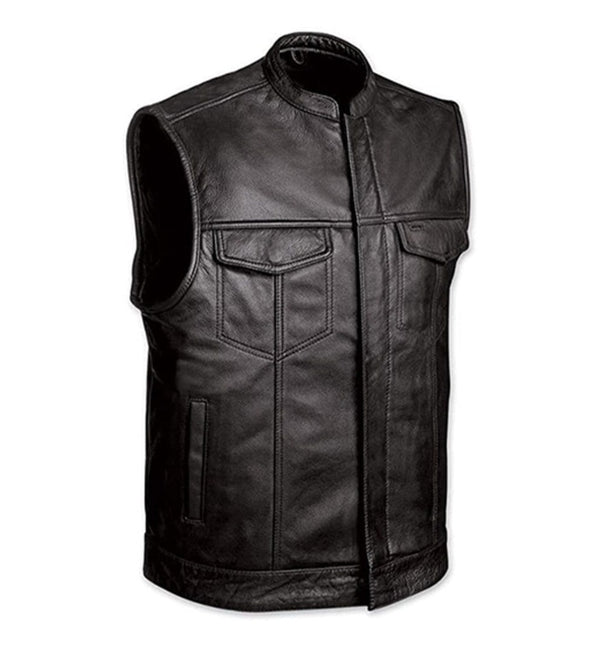
A pin only means something because the vest it sits on is already a message board. The American Motorcyclist Association formed in 1924, and through the 1920s and 1930s it gave awards to the best-dressed clubs, which pushed groups toward matching outfits and identifying patches, according to Heddels' history of biker cuts. Those early uniforms were sweaters, varsity jackets and overalls, which look nothing like a modern cut.
World War II changed the wardrobe. Veterans came home in flight jackets, khakis and blue jeans, and many joined clubs for companionship. In July 1947, roughly 4,000 riders attended the AMA's Gypsy Tour in Hollister, California. A sensational Life magazine article and, in 1953, the film The Wild One exaggerated what Heddels describes as a fairly tame weekend. The popular account holds that the AMA responded by saying 99 percent of riders were law-abiding, which gave the "one-percenter" label its origin.
Postwar bikers cut the sleeves off their jackets and sewed on colors, the patches that show allegiance. Heddels notes that cuts began as denim, moved to leather and eventually became available pre-made without sleeves.
Colors on a traditional motorcycle club vest follow a pattern: a top rocker with the club's name, a central logo and a bottom rocker naming the territory. Family clubs endorsed by the AMA often wore one large back patch instead, while outlaw clubs split theirs into three parts. Because the bottom rocker claims ground, territory has long been the most sensitive part of a vest. That is the setting in which the pass-through pin made sense.
Riders who want a vest that works as a blank canvas can start with motorcycle leather vests, browse motorcycle denim vests or look at patched vests that already carry artwork.
Walter Hunt received U.S. Patent No. 6,281 for his "dress pin" on April 10, 1849. The Lemelson-MIT program notes that Hunt apparently thought little of the invention and sold the rights for $400. His design combined a spring with a clasp that covers the sharp point, which is what made it safe to handle.
That history explains the pin's appeal across subcultures. It costs almost nothing, it is strong, it needs no tools and anyone can use it. Sailors used it on laundry bags, punks used it on torn clothing and 2016 campaigners used it as a badge anyone could afford. A biker clipping one to a cut belongs to a long line of people who found a use for it.
Before symbolism, there is function. Riders have long used safety pins for quick fixes: holding a loose patch in place, closing a torn seam on the road or attaching a small removable item. These are temporary solutions. For a lasting hold, sew the patch on with heavy thread or take it to a leather worker.
Leather adds one caveat. Fabric closes around a pin, but leather keeps the hole permanently. Pin through a patch backing, a seam, the lining or a denim panel, and keep the leather itself intact. Regular conditioning with a leather conditioner helps the surface stay supple around any stitching or hardware you add. Riders looking for something to pin to or sew on can browse biker vest patches.
The table below summarizes the most common readings. None is guaranteed, because a rider can wear any pin for any reason.
|
What you see |
Most likely meaning |
Where it comes from |
|---|---|---|
|
A large pin hanging low on the cut, or on the back below the bottom rocker |
Pass-through pin: passing through, no challenge intended |
Motorcycle club tradition, tied in club lore to WWII Navy laundry pins |
|
Several small pins on straps, patch edges or lapels |
Personal style, DIY repair or punk influence |
1970s punk fashion in New York and London |
|
One plain pin on the chest or collar |
Solidarity: "you are safe with me" |
The 2016 #SafetyPin campaign |
|
A pin carrying a charm, ribbon or event pin |
A personal tribute or memento |
The wearer's own history |
Size, placement and the company a pin keeps on the vest are the best clues. When the meaning matters, ask the rider politely instead of guessing.
The punk safety pin starts in New York. Richard Hell is widely credited with ripping his T-shirts and holding them together with pins in the mid-1970s. Malcolm McLaren, who managed the New York Dolls for a time, saw Hell and carried the look back to London, according to Rolling Stone's account of London punk fashion. There, McLaren and Vivienne Westwood ran the shop at 430 King's Road, renamed SEX in 1974.
The Sex Pistols made the pin famous. ANOTHER Magazine reports that their appeal to the safety pin was as practical as it was visual, with Johnny Rotten saying it stopped his trousers from falling apart. Rolling Stone adds that the look spread quickly among London's first wave of punk youth, who ripped their clothes and pinned them back together.
Punk and biker style overlap in leather, studs, hand customization and a refusal to look polished. Both cultures treat a garment as something you rework yourself, and both use patches and hardware to say who you are. A small pin on a vest may nod to that heritage with no connection to any club. For riders who like that edge, the spiked leather jackets collection carries the same attitude in a different cut.
The newest layer of meaning arrived in June 2016. After the United Kingdom's EU referendum, an American living in London who posted as @cheeahs suggested wearing an empty safety pin so that people facing abuse could spot someone who was a "safe" ally. Outlets including ATTN, Dazed and TheJournal.ie reported on the idea, which borrowed from the #IllRideWithYou campaign that followed the 2014 Sydney cafe siege. I-D noted that police chiefs had reported a 57 percent rise in hate crimes after the vote.
The symbol crossed the Atlantic in November 2016, when people began wearing pins after the U.S. presidential election. Critics argued that the gesture could be self-congratulatory and that being a safe person requires action, not an accessory. That debate is part of the pin's story, and anyone wearing it for this reason should be ready to back it up.
On a biker's vest, this reading is possible but context decides. A small, plain pin on a collar or chest suggests solidarity. A large pin hanging by a pocket points back toward club custom.
Several claims about biker pins circulate online without support. Sorting them out keeps folklore from passing as fact.
Club membership is shown through colors, not pins. A pin can reflect tradition, style, tribute or solidarity, so it should never be read as proof of affiliation.
An earlier version of this article described a pin near the heart as a pledge to a club. No source reviewed for this refresh documents a rule like that. The traditional pass-through position was the back of the vest beneath the bottom rocker, and today it is commonly a front pocket.
Reporting on the custom says otherwise. A pass-through pin was a gesture of respect, and even a one-percenter member cannot count on it today.
The safety pin dates to an 1849 patent, and club lore ties the pass-through custom to the postwar years. Punk adopted the pin in the 1970s, and the solidarity version is from 2016. The biker meaning is the oldest of the modern layers.
No official rulebook exists, and norms vary by region and club. The guidance below reflects customs described in the sources used for this article.
The pass-through pin was a courtesy, not a shield. SlashGear reports that even members of one-percenter clubs cannot expect a pin to guarantee safe passage today. Respect for local clubs and common sense still matter more than any accessory.
Territory and rank are serious matters on colors. Heddels explains that support-club members may wear the colors of a larger club but never its logo, and that the one-percent diamond is restricted to full-color members of major outlaw groups. The same article cites the 2015 Waco shootout, which left nine dead and 18 injured, as a reason to avoid cuts that resemble one-percenter colors. If you are not a member, do not copy a three-piece patch, a territory rocker or a diamond.
A pin's meaning is personal. Do not assume that a rider with a pin belongs to a club, and do not touch or adjust another rider's vest, pins or patches. If you are curious, a polite question usually gets a better answer than a guess.
A crowded vest can blur the message of every pin on it. Choose pins that mean something to you and place them where the meaning is clear.
Follow these steps to keep the pin secure and the vest intact:
A vest that fits properly also carries pins better, because a vest that pulls across the chest stresses every stitch. If you are between sizes, read this guide on how to choose and use vest extenders.
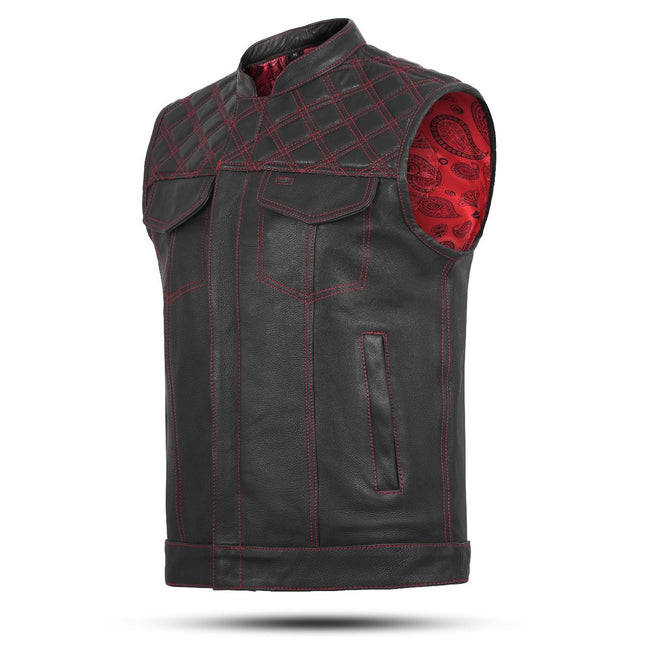
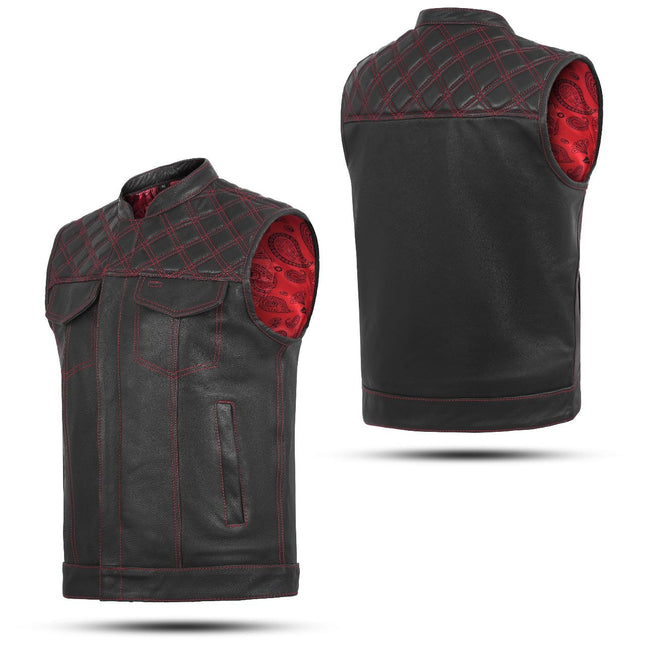
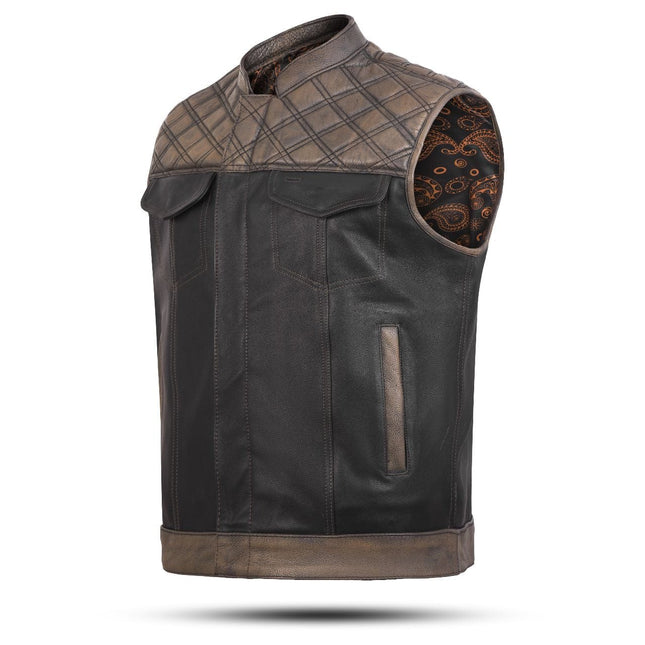
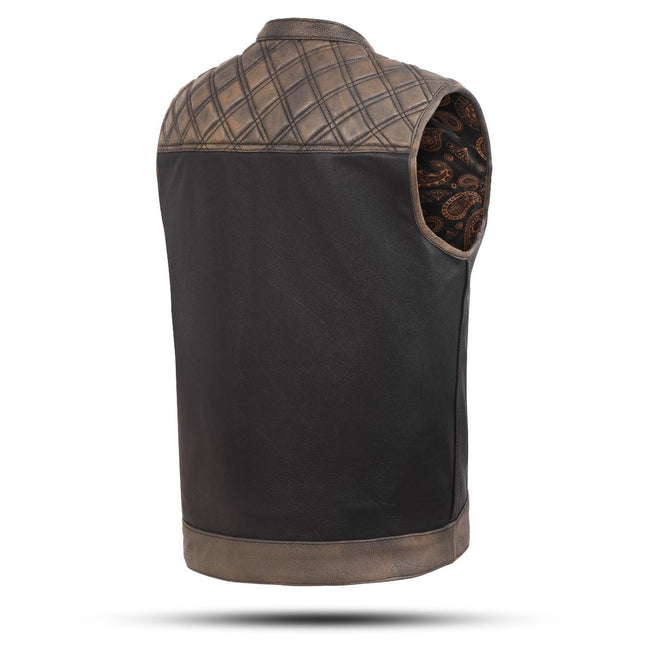
The vest underneath shapes how well it holds up to pins, patches and miles. Leather is durable and develops character with age. The Men's Brown Leather SOA Anarchy Motorcycle Leather Vest and the Red Leather Diamond Stitch Motorcycle Vest are two options for riders who want a classic look. Denim suits riders who prefer a lighter, easier-to-customize base, such as the Men's Black Denim Club Vest with Genuine Leather Trim.
Women riders can explore women's leather vests and women's denim vests. Anyone weighing a vest against protective gear can compare the two in this guide to biker armor and a leather motorcycle vest. To keep a customized vest in shape, the Large Leather Care Kit covers cleaning and conditioning in one purchase.
Usually it is a pass-through pin. Traditionally, a club member wore it when riding outside the club's territory to signal respect and show no intent to set up a rival chapter. The tradition has faded, so a rider wearing one today is often honoring old-school custom.
Originally on the back of the vest, directly beneath the bottom rocker, so clubs riding behind could see it. Today it more often hangs from a front pocket of the cut.
Not necessarily. A pin can be a club tradition, a punk-style accessory, a personal tribute or a solidarity symbol. Club membership is shown by colors: the top rocker, the center logo and the territory rocker.
Wearing a pin is generally not an offense, but copying club insignia is. Avoid territory rockers, club-style logos and the one-percent diamond unless you are entitled to wear them, and do not assume a pin gives you any protection.
In fashion, it is tied to punk's do-it-yourself look from the mid-1970s. Since June 2016, it has also served as a symbol of solidarity, introduced in the UK after the EU referendum and later adopted in the United States. Some critics call it a symbolic gesture that needs action behind it.
The safety pin on a biker's vest has no single meaning, but it is not meaningless either. The most specific tradition belongs to the pass-through pin, a courtesy worn by club riders crossing another club's ground, with roots in post-war veteran culture and Navy laundry bags. Around that core sit newer layers: punk's torn-and-pinned clothing and the solidarity pins of 2016.
Before pinning anything to your own vest, decide what you want it to say and where it can sit without damaging the leather. Then build the rest of the look on a vest that can take years of patches, pins and miles.
Built for the Road. Ready for Your Patches. Shop Leather Biker Vests




$129.95 - $159.95
$139.95 - $169.95


$139.95 - $169.95